Interesting threads:
- How much maths can be Lean-formalised, and how much of that is constructive? Zulip
8 recent unread papers on desk:
1. Steady 2D Euler flows (classification theorem), arXiv
2. Dualizable Additive Categories, arXiv
3. Calculus and Cohomology, arXiv
4. Blowup and non-uniqueness, arXiv
5. Geometrization of the Local Langlands Correspondence, Motivically, arXiv
6. On the irrationality of certain series, paper
7. Introduction to Homotopy Type Theory, arXiv
8. Condensed Mathematics and Complex Geometry, arXiv.
Recent talks:
1. Geometric Langlands Duality with generalised coefficients, youtube
2. Math experiments, pdf
3. Ramsey Numbers, youtube.
4. Langlands program, youtube.
5. Irrationality of a specific form of L-function, youtube.
6. Dustin Clausen: New foundations for functional analysis, youtube
Favourite papers:
1. Geometrisation of local langlands correspondence, motivically, arXiv
2. Motivating motives, arXiv
3. Arithmetic groups and Automorphic forms, arXiv
Good essays:
- What will you achieve in the next three years? Lawrence Hollom
(“The model thinks and chugs away and the fans on my PC whir into life. A few minutes later, it produces a response, crawling out one word at a time, while the frontier model in a data centre who-knows-where rattles through layers of protocols and hammers out lines of Lean by the thousand”.) - Who Will Lead Mathematical AI? Helmut H. W. Hofer
(“Institutions such as the Department of Energy naturally think in terms of missions, engineering goals, infrastructure, and deliverables. There is nothing wrong with that. But in my experience, many engineers have felt that they already knew the mathematics they needed. They were not always particularly interested in mathematics as an independent intellectual force. AI makes a stronger version of this attitude possible: Why involve mathematicians in setting the direction? AI will do the mathematics for us.“)
List of all collaborators:
- Physical systems:
a) Prof. Ian Wilson
b) Prof. Angkur Shaikeea - Complex systems:
a) Prof. Walter Federle
b) Prof. Andrew Adamatzky
c) Dr Giuseppe Tarabella
d) Dr Victor Kang - Computing with neural networks:
a) Dr Giulia Marcucci
b) Adnan Mahmud
c) Rishav Karki
d) Rishit Mohan Ahuja
e) Haydn Cheong
Other blogs
- Terence Tao
- Peter Scholze
- Dustin Clausen
- Laurent Lafforgue
- Timothy Gowers
- Gil Kalai
- Ishan Levy
- Arpon Raksit
- Zeb Brady
- Sanath Devalapurkar
- Linli Shi
- Scott Aaronson
- Joel David Hamkins
- Lawrence Paulson
- n-Cafe
- Michael Levin
- Vitalik Buterin
- Communications of ACM
- Ru Wang
Catalogue
Seminars
1. IAS
2. Oberwolfach
3. INI1, INI2
4. ICMS
5. Fields Institute
6. Virtual
Some handy tools
1. https://axi.lims.ac.uk/
Problem Sets
Favourite Quotes
John H. Conway, mathematician, and his quote in an interview,
“And then, when the ICM opened, no French delegation. That was the terrible thing. I am tearing up now. Because after a time, French team marched in with Poincare holding together and about 20 people came in, and everybody burst into spontaneous ovation. Anyway, that’s an aspect of Cantor’s influence on mathematics that you might not have been aware of“.
Letters/Notes/Pictures
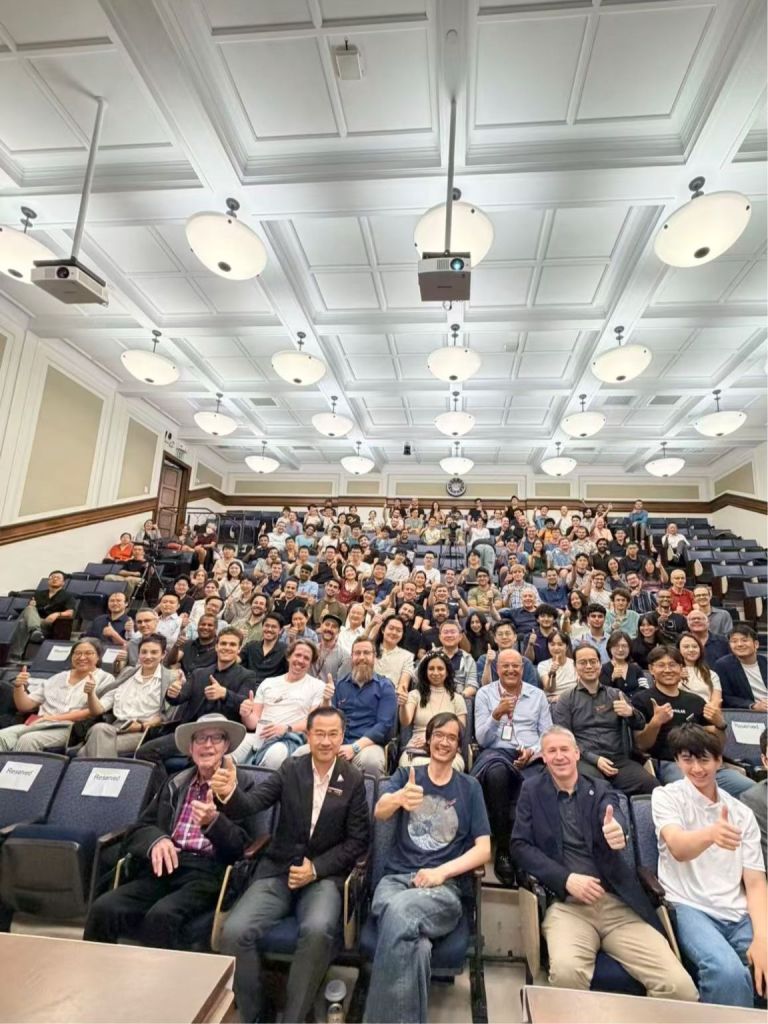
- SAIR, Caltech, Sept 2026
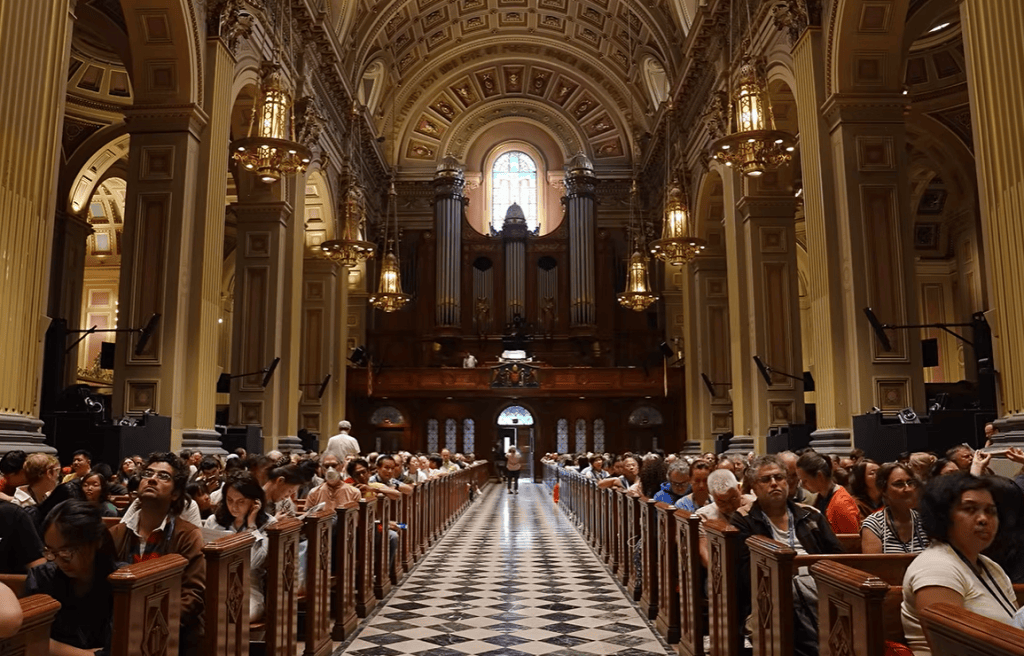
- ICM, Philadelphia, July 2026
- Commentary article on “Path Induction and the Indiscernibility of Identicals”, Hardy Lecture 2025 (pdf)
- Big Proof, June 2025

- Equivariant Homotopy Theory, Jan 2025

3. Letter on the potential connection between Sarnak’s conjecture and an error function (21st Dec, 2024).
4.Lecture Notes, Fluid Dynamics Barcelona September 2024 (notes here and blog here)

5. Giulia Marcucci and Jeremy Delhommeau, September 2024.

6.Twistors in Geometry and Physics September 2024 
7. “It from bits: Fluids” art exhibition in the “Navier-Stokes regularity, fluid computing & machine learning workshop” with guest Hardy lecturer Prof. Eva Miranda June 2023


8. JFM Batchelor Centenary 2021

Some old papers on the desk:

