In the 2026 ICM lecture, Jacob Lurie discussed developments in last one decade or so in  adic geometry and the conjectures initiated/inspired by those developments. Lurie offers two lenses: algebraic topology and algebraic geometry to understand these lenses, starting first the the algebraic topology.
Complex  theory is an example of the invariant of topological spaces. Let
 be a “nice” topological space (such as, compact manifold, finite simplicial complex) with a complex vector bundle
 defined on it having an addition law gives by the formation of direct sums which makes a collection
 of isomorphism classes into a commutative monoid with addition
 (but not subtract them). However, still, it’s possible to make a group by formally adjoining the inverses; definition given by the Atiyah-Hirzebruch 1960, where the complex K-theory of is the abelian group
 one gets after the procedure above. For example, if consists of a single point, then its vector bundle is just a vector space, and up to an isomorphism, it is classified by a dimension which is natural number and upon formally adjoining its inverses, one gets the group of integers (
 ).
One can define a sequence of invariants for all spaces and integer  given by

which is an example of generalised cohomology theory (properties like, long exact sequences, excisions, torus);  -theory has all features except that -theory of a point is not in degree zero and it is a copy of integers in every even degree, given by the Bott periodicity (1960)
 if is even and it is = 0 if is odd.
In 1930s, Hopf introduced fibrations  ,
 , and
 using division algebras over
 , and an immediate question that appeared in 1935 was:
when does there exist a map of spheres  behaving like a Hopf fibration? This was answered by Adams 1960 in negative except for
 . While the original solution used secondary operations in ordinary cohomology (85 pages) but was reduced to 8 pages using complex K-theory by Adams-Atiyah in beautiful 8 pages.
The counterpart of K-theory in the world of algebraic geometry is to look at the finitely-generated projective modules over a ring (analogue of vector bundles). Let be a ring and  be a finitely generated projective
 module with its isomorphism class
 forming a commutative monoid with addition law
 . This can be made a group by formally adjoining the inverses, which is the abelian group, given by
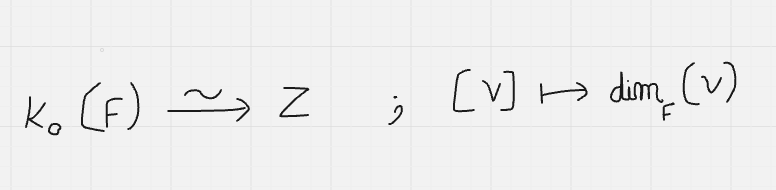
 . For the ring which is a field, the K-group is just integers,
Algebraic K-theory is given by higher K-groups of R,  introduced by Quillen in 1970s and appears in generalization of Riemann-Roch, K-groups of rings of integers (L-functions), surgery classification of manifolds and obstructions.
A broad question is to compute or understand the groups  ; for example, the higher K-groups of
 are not completely known yet (except the order of these groups due to Antieau-Krause-Nikolaus). Higher K-groups in this example are finite groups so they split into sum of odd and 2-torsion part; the latter (2-adic part) is difficult.
The cyclotomic trace of Bokstedt-Hsiang-Madsen is given by

which is useful because the approximation is good by some measures are computable by some measures. Note that  denotes the p-complete topological cyclic homology of R.
On a bad note: the first pointer is that is p-complete and depend on p-completion of , which is not shared by algebraic K-theory. Secondly, TCH (topological cyclic homology) satisfies a strong local-to-global principle (etale descent) which K-theory does not.
On a good note: Clausen-Mathew-Morrow 2020 proves that if is p-complete, the cyclotomic trace  exhibits as TCH as what one gets from algebraic K-theory by forcing it to have three properties (in previous paragraph).
Therefore, TCH is a good approximation to K-theory. How computable is  ?
The groups extracts its mathematical content from THH(R) which is always p-complete and is an example of cyclotomic spectrum. About cyclotomic spectra, they form a tensor category (algebras, modules over them) and a triangulated category (Ext groups).
For a ring R, one can regard it over a ring of Z, and hence,  is a module over
 . In the world of cyclotomic modules over THH(Z),
 .
One would be interested in understanding plus some extra work to understand .
Bokstedt Periodicity 1985 showed that  with
 . Thus, if R is an
 algebra (any ring where p=0), then,
 . So THH is reduced modulo a generator to get a more concrete ingredient called HH (Hochschild Homology; at the level of chain complex and understod well). A key theorem here is Hochschild-Kostant-Rosenberg 1962 given by
For a smooth over  ,
 =
 , which are groups of algebraic differential forms for the ring R.
Therefore, computing THH(R) is one “spectral sequence away” from understanding algebraic differential forms.