New Foundations for Function Analysis: part 0, c.f. Clausen, D. (2021)

Historical note around Serre, Borel, and Leray:

These notes were written on the occassion of centennial birthday anniversary of J.P. Serre, which was celebrated in the form of a conference, Serre 100, at Institut Henri Poincaré, Paris. The talks are accessible here. This event reminded me of an insightful and heartwarming special plenary lecture given by Peter Sarnak during ICM 2026, titled, “Maestro Jean-Pierre Serre”, accessible here, where Sarnak recounts in the 36th slide a historical anecdote on Serre dropping out of Leray’s class and being later communicated by Borel on spectral sequences. For those who are experts in analysis and those in algebraic geometry, but not both, the details of this anecdoate goes as follows. Jean Leray, after his work in obtaining global in time, weak solution v \in L_{\infty}^{t}L_{x}^{2} with regularity L_{t}^{2}\dot{H}_{x}^{1} to the 3D incompressible Navier-Stokes equations whilst obeying energy inequality || v(t) ||_{L^{2}}^{2} + 2 \nu \int_{0}^{t} ||\nabla{u(s)}||_{L^{2}}^{2} ds \leq ||v_{0}||_{L^{2}}^{2},(c.f., Sec 1.1), had turned to his sheaf theory (detailed account in the third para here) with three papers published in 1942. Upon his return, he lectured at College de France and J. P. Serre was one of his first student. Because of the abstruse and abstract nature of Leray’s lectures, Serre dropped out, while his friend Borel did not. To answer a question if the Euclidean space are fibered by compact fibers, then are these fibers points, Serre used a corner argument, later called Leray-Koszul sequence to answer it positively (an insightful Stack Exchange thread on differences in Leray’s and Serre’s sequence is here). Later, Serre used path-space construction to generalise this for any space X and thus, generalising the definition of fibration (that we now call, the homotopy lifting property). The historical account is here and the reference slide from Sarnak’s talk is here.

Part 1: Introduction

The philosophy of doing analysis, without using classical approach of beginning “functional analysis” using the notion of topological \mathbb{R}- vector spaces, stems from a nascent, analysis-free analysis approach in the school of Bonn and Copenhagen. The classical approach is usually to start with a topological \mathbb{R}- vector spaces and restricting it to a subcategory (upon imposing a completeness condition) of a complete, locally convex topological \mathbb{R-} vector spaces (e.g., Banach, Fréchet spaces). The Bonn-Copenhagen school suggests to replace this approach with a new notion; that, of a condensed \mathbb{R-} module (module and vector space have the identical meaning) which contains in itself a p-Liquid \mathbb{R}- module.

The theory of topological spaces (built with mathematical objects like family of subsets) is a difficult notion to work with when doing algebraic manipulations on such objects (as algebra has to do with points and equations).

The idea behind the replacement is that the topological spaces which are built upon mathematical objects like family of subsets are usually difficult, despite numerous successes, to work with, especially when one is interested to do algebraic manipulations, in comparison to a new notion like a condensed set which can be piled upon algebraic structures much nicely. The reason is that the topological spaces have features like family of subsets, distinct from the features like points and equations in algebra, and therefore not so nice to be piled down on algebraic manipulations, and the condensed sets are inherently algebraic in nature. Notably, the theory of Bornological spaces by George Mackey is an adjacent theory, yet distinctive to the Bonn-Copenhagen school (see Comment 1).

Now we work our way up from condensed \mathbb{R-} to p-Liquid \mathbb{R-} module.

Idea of continuous maps. We encode a topological (target) space X just by encoding a set of continuous maps S \to X, where S is a profinite set (identically, it is a topological space S = \varprojlim S_{i} given by an inverse limit of finite, discrete sets S_{i}; in other words, it is a compact, totally disconnected Hausdorff space). E.g., \mathbb{N} \cup {\infty} (sequence with a limit point), p-adic integers, and not a unit interval [0,1] (see Note 1.2 below)).

The question now is: why should this encoding remember enough about X? One can break the answer up into two reasons:
1. If X is compact Hausdorff, then \exists profinite set S (also called Stone space) and a quotient map from S \to X , and to understand how to get X from S through this quotient map, one would have to look at a fibre product built from X and S, which is also profinite. To summarise so far, the compact Hausdorff things need to be resolved by profinite things.

Note 1.1: Naively speaking, for ordinary spaces which are metrisable, a standard way to reason is through convergent sequences, like \mathbb{N} \cup \{{\infty\}}. In the sense of Bonn-Copenhagen school, for metrisable topological spaces, it already is enough to remember about convergent sequences, and there are reasons (detailed below) to extend this encoding beyond to all (why all?) profinite sets.
Note 1.2: In fact, a unit interval $[0,1]$ which prima facie is not profinite, but can be resolved to be profinite using decimal expansions, \mathbb{T}\{0,1,...,q\} \to [0,1]; this space is a product of finite sets which surjects as a quotient map to the unit interval. It is not an isomorphism because, for e.g., 0.0999.. is not 0.1, and thus there is some gluing that has to happen, and that gluing itself is profinite.

2. Many topological spaces are determined by their compact Hausdorff subsets. E.g., metrisable ones; locally compact Hausdorff ones; CW complexes in alg.top.

To conclude part 1, it is enough to remember set of continuous maps from profinite sets for every topological space one encounters.

Part 2: Definition and central theorem


Condensed set: Definition.

A condensed set is a functor, denoted by X (earlier used for topological space), defined as

X: \textrm{Prof Set}^{\textrm{op}} \to \textrm{Sets}.

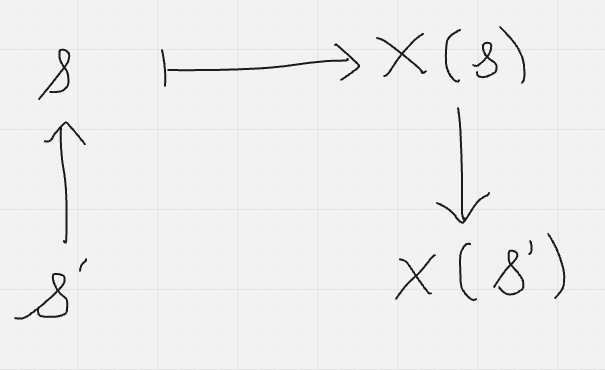
Thus, for every profinite set s, one can assign X(s) (can be thought as standing for the continuous map from S to X). Because X is a functor, one can have a map s' \to s, which by composition, gives, X(s) \to X(s'), such that

  1. X(\bigsqcup_{i} S_{i}) \overset{\sim}{\rightarrow} \Pi_{i} X(S_{i})
  2. If S' \to S, then X(S) \overset{\sim}{\rightarrow} X(S') \overset{\rightarrow}{\rightarrow} X(S \times S') (rewrite it)

(It is important to note that non-Hausdorff quotient spaces, which loosely speaking are difficult quotient spaces, are condensed sets and not ordinary topological spaces. This is useful for non-commutative geometry. There are plenty of examples, to be noted later, where for the non-Hausdorff quotient spaces, the topological structures are not enough, but condensed sets are enough).

The category of condensed sets is an example of Grothendieck topology (topos); and has properties very similar to the category of Sets. For mixing with algebraic structures, Abelian group objects, modules, ring objects, etc. in a general topos behaves very much like in the category of Sets (because, formally, finite limits – which are to do with algebraic structures – interact with colimits – which are how one builds things – exactly as in the category of Sets).

In fact, it’s better behaved that most topoi. Why?

Because there are some very special profinite sets.

\forall S \in \textrm{Prof Set}, \exists a surjection, a quotient map S' \rightarrow S, such that S' is extremely disconnected (meaning that it is a projective object in the category of ProfSet). So, having further surjection from S'' onto S', there is a split, and one doesn’t get more data after this surjection.

Thus, one can redefine condensed sets to be functors,
\textrm{Extr Disc}^{\textrm{op}} \rightarrow \textrm{Sets}

and, now, one only needs the first condition X(\bigsqcup S_{i}) = \Pi X (S_{i}).

(It behaves like presheaf topology, plus, the first condition).

To conclude this part, extremely disconnected spaces are better than sequence spaces and the category of condensed sets behaves similar to the category of sets.

Part 3: One consequence

Passing to condensed abelian groups

Let us now mix algebra here, by replacing the category of condensed sets with the category of condensed abelian groups. There are two ways forward to this: either take abelian group of maps from S to the target, or, take abelian group object in the category of condensed sets with the multiplication map satisying ablian group axioms.

The condensed abelian group, in general, is an abelian category, with enough compact projectives (here, projective means that it has a lifting map along surjections, and compact means, that the map into an infinite direct sum, it always through a finite direct sum; for example, for modules over a ring, the compact projectives are always the finitely generated projective modules, which means that convenient homological algebra is possible here). It is to be noted that the compact projectives are free, condensed abelian groups on extremely disconnected \mathbb{Z}[s].

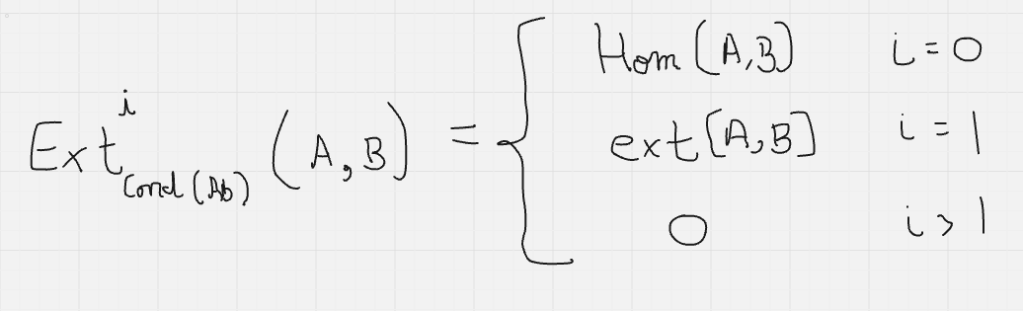
In an abelian category, where locally compact abelian groups A,B observe a

Theorem.

It is similar to what happens for discrete abelian groups (it is one Ext and then vanishes). A is resolved using \mathbb{Z}[s].

Turn to condensed \mathbb{R-} modules

Let \mathbb{R} be a condensed ring, which lets one define a notion of module \textrm{Cond}_{\mathbb{R}} (this notion can be supplanted to a sheaf-like definition; or alternatively, can be defined as, a condensed abelian group with an action by \mathbb{R} satisfying the axioms). \textrm{Cond}_{\mathbb{R}} is an abelian category with enough compact projectives. These projectives are now free, \mathbb{R}-vector spaces on extremely disconnected profinite sets \mathbb{R}[s]. This is an analogue to topological \mathbb{R}- vector spaces (though just like there are examples of not-complete such spaces); therefore, one needs completeness condition, for example, crucially, to form completed \otimes^{1} S.

Theorem For S \in \textrm{Prof Sets}, \exists a certain space of measures \mathcal{M}(S) on S (measure \mathcal{M} is not defined for now), such that the following holds:

  1. Natural map: \mathbb{R}[S] \rightarrow \mathcal{M}[S]; this is a finite sum of Dirac measures with real coefficients (algebraic free \mathbb{R}[S]) is passed to a general class of measures (performing some kind of completion).

    finition. A condensed \mathbb{R-} module V is liquid if it satisfies the condition
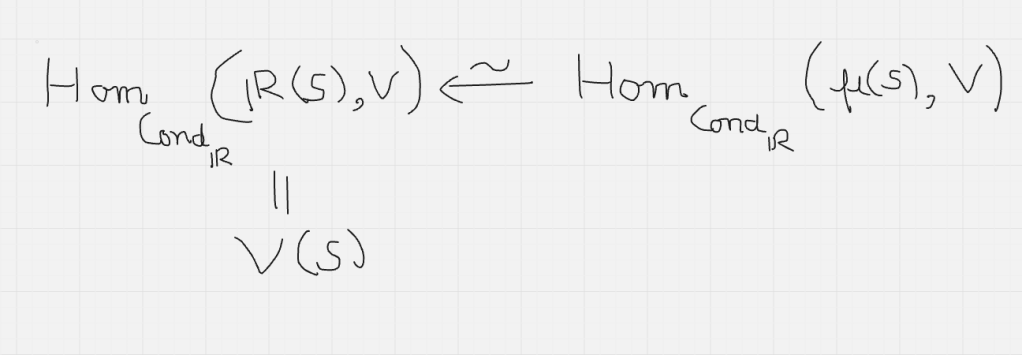
    which is interpreted as the following: in liquid vector space, one can integrate functions along certain measures, and it belongs to the space \mathcal{M}(S). There is a unique way from meaures on S to V.
  2. \textrm{Liquid}_{\mathbb{R}} \subseteq \textrm{Cond}_{\mathbb{R}} Liquid vector spaces inside \mathbb{R} are under \textrm{Cond}_{\mathbb{R}} are closed under all limits and colimits, for example, products, kernels, direct sums, and cokernels.
    Since it is closed, it is an abelian category with enough compact projectives \mathbb{M}(S).
  3. \textrm{Liquid}_{\mathbb{R}} is an abelian category with enough compact projectives = \mathcal{M}(S)
  4. \textrm{Liquid}_{\mathbb{R}} \subseteq \textrm{Cond}_{\mathbb{R}} is closed under extension, but also under higher extensions, \textrm{D(Liquid)}_{\mathbb{R}}) \subseteq \textrm{D(Cond)}_{\mathbb{R}}
    For all V \leftarrow \textrm{Cond}_{\mathbb{R}}, \exists initial V^{\textrm{liquid}} \in \textrm{Liq}_{\mathbb{R}} with a map V \rightarrow V^{\textrm{liq}} and a completion functor from V to V^{\textrm{liq}}
  5. \exists a \otimes^{\textrm{liq}} on \textrm{Liq}_{\mathbb{R}}, with V \otimes^{\textrm{liq}} W := (V \otimes X)^{\textrm{liq}} which behaves well algebraically and commutes with cokernals and direct sums, and behaves like modules over a commutative ring.

Note. Ordinary Nuclear spaces are part of it and this formulation above includes all such examples.

Why a certain theorem fails?

If V,W \in Nuclear, dual Nuclear Frechet spaces, then the

V \otimes^{liq} W = V \overset{\hat{}}{\otimes} W (the latter is, say, a projective tensor product) (the spaces of C^{\infty} and holomorphic functions fall here).

Note. The spaces of NF, are by non-trivial isomorphism, are same as sequences of rapid decay (by non-trivial isomorphisms). The self-map of such spaces: continuous maps from sequences of rapid decay into themselves (morphisms in category above) and their multiplication with e^{\textrm{-n}}, gives natural map which is not surjective and thus not a isomorphism. To know, there is a cokernel to this map, it is disturbing to an analyst; and though, cokernal is the quotient of sequences of rapid decay with the sequences that decay exponentially fast. This space can be considered to go into (problem of non-commutative geometry); in the sense that dual of this space, which is \textrm{Hom} of this space to \mathbb{R} is zero (standard). Except, that, there would be multiple \textrm{Ext}.

Let us discuss the space of measures. Most naive choice for \mathcal{M}_{1}(s). One needs S \rightarrow \mathcal{M}(S) which needs to be continuous, and thus is discrete in Banach and not useful, a perfectly nice topology on which set S is compact and one can scale up from there. This is topologically dual to the space of continuous functions. But, this turns out to fail, because of entropy.

A construction. Let us take S = \mathbb{N} \cup \{\infty\} but collapse out the infinity and thus make a sequence space.

The usual sequence space is l^{1} (weak dual; convergent ball is compact instead of being in Banach world) which falls inside l^{\infty}. One can take a quotient l^{\infty}/l^{1} which is non-Hausdorff, which is what the theory wants to include, and using entropy, one can make a map l^{1} \rightarrow l^{\infty}/l^{1}, and thus this map, send the sequence (X_{n}) \rightarrow (X_{n}. \textrm{log}(X_{n}))_{n} which is almost linear, in the sense that entropy relation satisfies an inequality, which is not linear, but close to being linear, and thus one gets a condensed \mathbb{R} map, and on the basis vector, this map is zero.

These spaces l^{1}, l^{\infty} would be liquid for M=M_{1}, but l^{\infty}/l^{1} cannot be. This contradicts the uniqueness in liquid definition.

Solution Let us pass to a non-locally convex

\mathcal{M}_{q}(s):= \bigsqcup \varprojlim \mathbb{R}[S_{i}]_{l^{q} \leq N} for 0 < q \leq 1.

For 0 < p \leq 1, define

\mathcal{M}_{<p}(s)= \bigsqcup_{q<p}\mathcal{M}_{q}(s), this works.

There is no way to get algebraic properties and stay in locally convex spaces. However, one can relax the completness condition and add new things to get good algebraic properties in category of complete things.

Nuclear module

A module is nuclear, it’s when the space of measures, the continuous functions from S to \mathbb{R} and liquid tensor product it with M; the underlying vector space, it maps for formal reasons, from S to M, and that this map is isomorphism, and every map from S to M should be trace-classed (internal to this theory); and every map in complex (derived) projectives is trace-classed; trace-class helps in ignoring l^{1} from l^{\infty}; class of nuclear modules helps in removing subtlelties, and upon specialising to locally convex wrinkled space, being an abelian category, which contains NF and DNF. The semi-norm could be fixed to get Banach space, which is complex, and inverse limit of BS. In the current theory, one builds from colimits to dual of this Banach space, which are also called Smith spaces, which is convenient. These limits are not countable, which is an upsetting feature. Hilbert space are not nice in this theory (they are awesome due to their duality). One can take geometry of manifolds to understand from this theory. Things like analytic torsion, Reidemester theorem.

Serre duality (complex analysis in the lens of analytic geometers)

If M is a compact, complex manifold with connected dimension d and one takes holomorphic vector bundle E mapping to M, and the

\textrm{H}^{i}(M;E)^{v} \cong \textrm{H}^{d-i}(M;\Omega^{d}\otimes E^{v})

If one removes the compactness, this fails. The LHS is finite-dim vector spaces, and in general, infinite dimensional vector spaces. One way to calculate these cohomology groups using Čech complexes based on covering by Steins, and in these Čech complex, it’s no guarantee that image is closed, so there would be non-Hausdorff quotients, which is annoying.

If M is general, one can rescue Serre duality in some sense by, in one side, replaced cohomology with compactly supported cohomolgy.
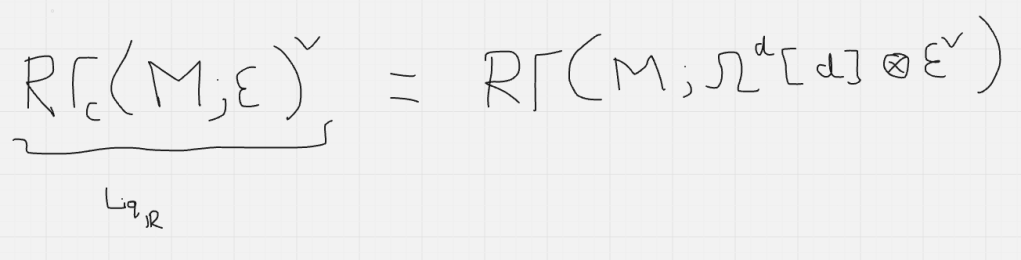
is a statement in the derived liquid vector spaces.

If M is a finite union of Steins, there is at most an \textrm{Ext}^{0,1}(\textrm{H}_{c}^{i}(M;E), \mathbb{R}) which breaks up into short exact sequences on the level of cohomology groups. Similar to Poincare duality with integer coefficients for compact, real manifold, one has in this case, naively speaking, dual to cohomology in complementary dimensions, with \textrm{Ext} terms coming from cohomology in degree below.

The takeaway is that these non-Hausdorff spaces behaving no worse than torsion abelian groups; indeed when \textrm{Hom} are trivial, but \textrm{Ext} are not.

Comments

Acknowledgement The contents of these notes are largely derived from a Global Noncommutative Geometry seminar (link).

Published by Saksham

Ph.D. graduate in fluid dynamics from the University of Cambridge

Leave a comment