Recently, I had an opportunity to visit the Einstein Papers Project (EPP), a centre that is currently compiling, organising, and publishing all the major and minor written works by the great 20th century theoretical physicist Albert Einstein. This centre is born out of the efforts from Einstein’s secretary Miss Helen Dukas and close friend Otto Nathan, and later joined by John Stachel, who helped in the process of collecting material as a document editor, after organising the manuscripts and letters at the Institute of Advanced Study. The history of EPP is summarised here.
This was followed by the financial support from the National Endowment for the Humanities, National Science Foundation, Harold W. McGraw, Jr. Endowment, and the Arcadia Fund which helped in setting up Einstein Papers Project that we know of today, with 14,000 scientific and non-scientific documents, projected to reach up to 30 volumes once completed. Notably, the digital archives project of EPP had been free until 2025 but will soon be covered under the pricing model beginning 2026 who database will be digitised and made available worldwide by the academic publisher De Gruyter Brill.
Currently, the institute houses 18 employees in 2 floors, where the published volumes, portaits, old photographs, montages, and documents related to Einstein are displayed (please see the collage below). The visit to the institute is by appointment.


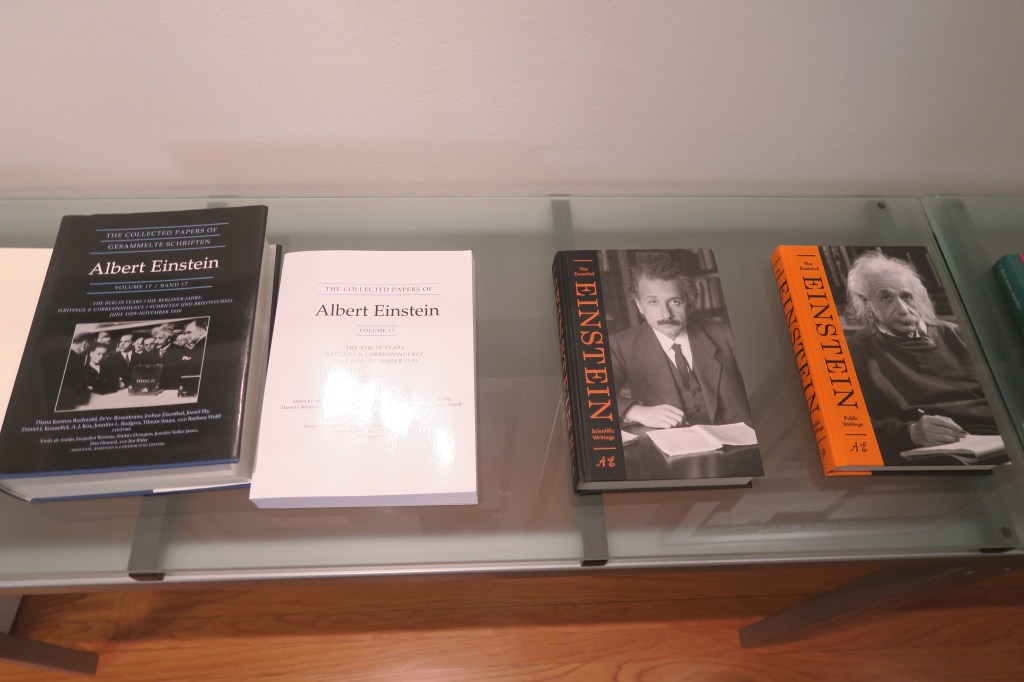

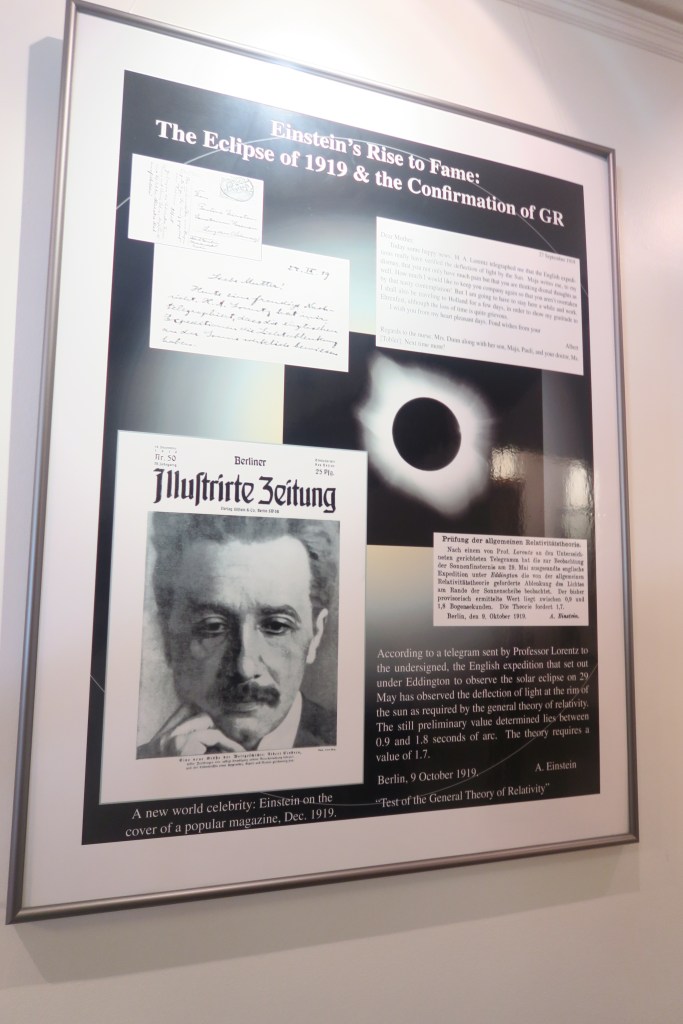

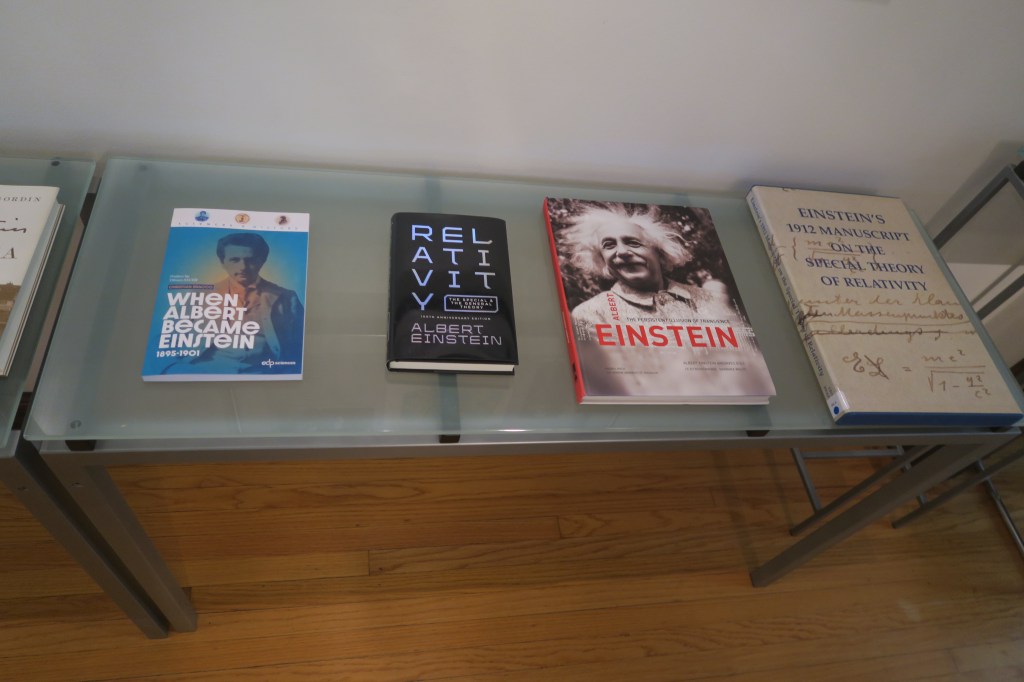
Despite the short notice, I was kindly hosted there by Sarah E. (Emily) de Araujo who showed me the quiet place in the common area of the institute where the collected volumes 1-17, spanning years 1879-1930 are kept. The digital version of these volumes are here.

The primary purpose of visiting EPP for me was to find the original document where Einstein referred to Kepler’s work of finding the Mars orbit as the work of “pure genius”, as recently highlighted in 3B1B video featuring Prof. Tao. In this blog, in the comment section, it was being made clear that in fact, the actual comment was “an idea of true genius” written by Einstein in the introductory paragraph in Carola Baumgardt’s “Life of Kepler” 1953.
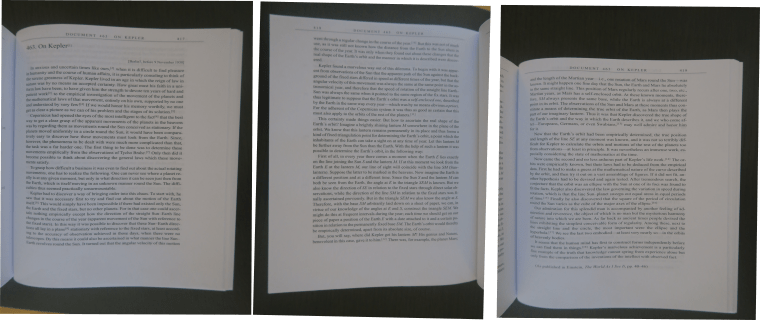
I had vaguely remembered reading somewhere that Einstein originally discussed Kepler’s idea in a newspaper article, which upon a quick google search before my visit to EPP, turned out be an article written by him on 9 November, 1930, titled, “Über Kepler” (in german). The most recent published volume in EPP had just covered Einstein’s works until 1930. I got lucky to be able to find the article that I was looking for. The images I took from the book are attached below.
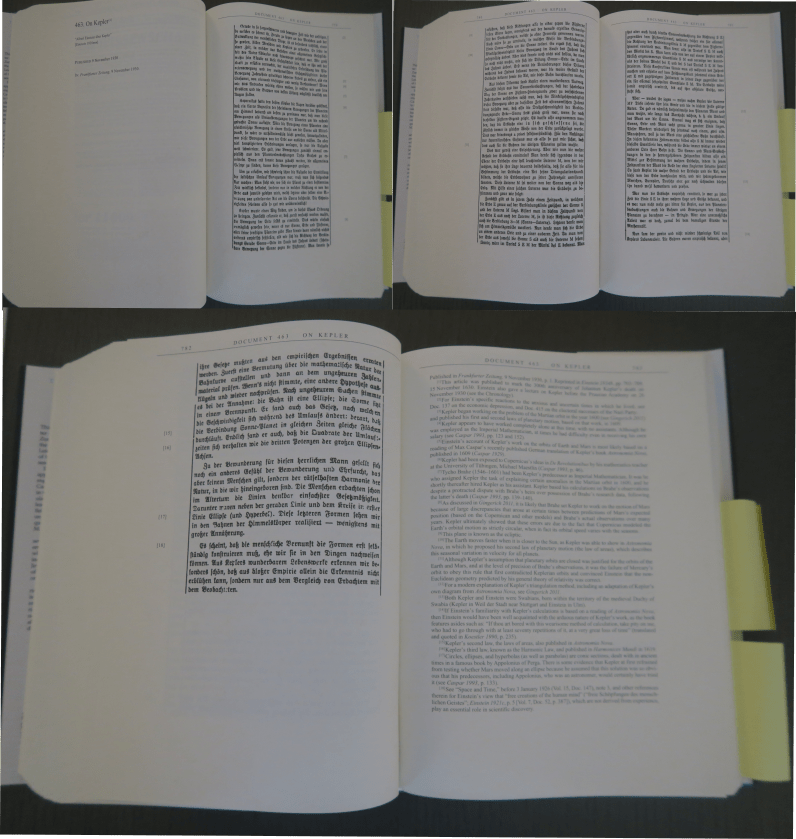
The translated version of the article in English is accompanied in the texts below.
A minor archival note
In the discussion below, a particular phrase where Kepler is referred to as genius is traced backwards chronologically.
In Über Kepler, the phrase used by Einstein to describe Kepler’s work is shown below (highlighted).
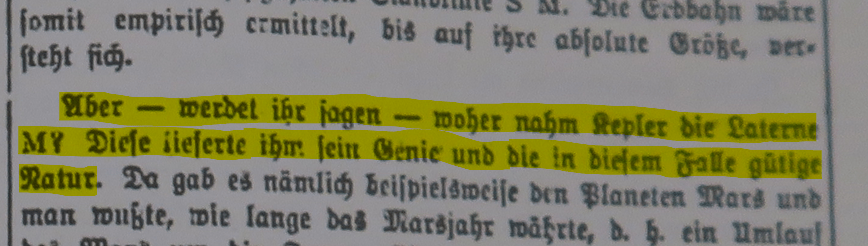
The English translation of this reads:

Sarah kindly shared with me the digital version of the original newspaper extract from 9 November 1930 issue of the Frankfurter Zeitung.

where this German phrase appears
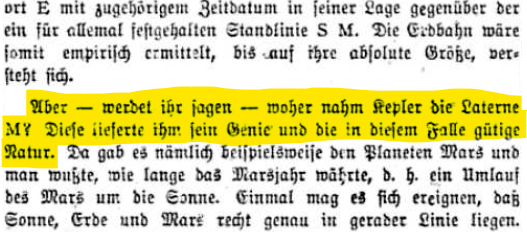
The original print of this newspaper is available in Microfilm archives of Frankfurter Zeitung 1918–1943, Library of Congress (Washington, D.C.) and Deutsche Nationalbibliothek Frankfurt.
Another place where the phrase containing the word “genius” – dictabat mihi genius – appears is in Lanczos, C. (1964). The Inspired Guess in the History of Physics. Studies: An Irish Quarterly Review, 53(212), 398-412.
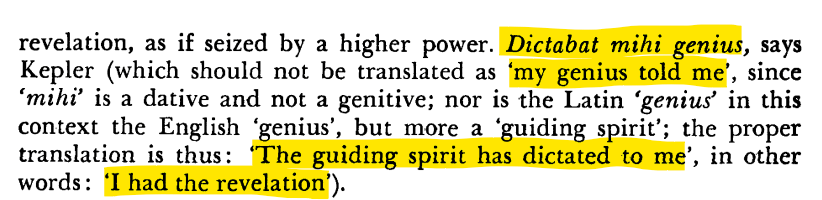
Now that we have gone spanned 1964 to 1930, one might ask: how far can we go further back to trace back the quote on Kepler’s genius?
The terminal point while tracing this back is the multi-volume collected works of Kepler published by C. H. Beck in Munich where the phrase dictabat mihi genius appears in the following paragraph
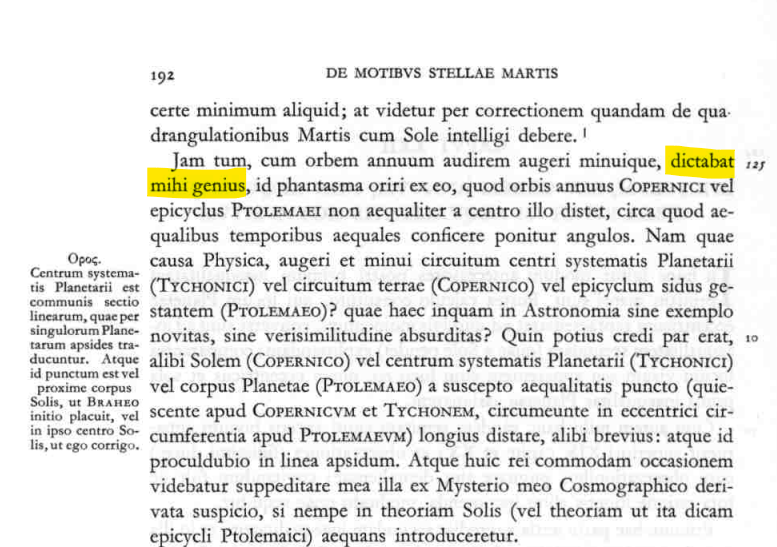
from the chapter Commentariorum de Motibus Stellae Martis (Commentaries on the Motions of the Star Mars), in the third part of Astronomia Nova (1609).
One of the original texts of Astronomia Nova (1609) that contains this phrase, used by Kepler, was sold for USD 327,600 on 28th Jan, 2025, following an auction at Christie’s.
This could be an interesting study suitable for archivists and the historians of science.
P.S.:
Because of lack of time, I couldn’t manage to find other works of Kepler, translated in EPP, that I was interested in, but perhaps postponed until the next visit. The ones I am interested in are:
- “Folgerungen aus den Capillaritätserscheinungen” (Conclusions drawn from the phenomena of capillarity)
- The Brownian motion (diffusion) paper: “Über die von der molekularkinetischen Theorie der Wärme geforderten Bewegung von in ruhenden Flüssigkeiten suspendierten Teilchen”
- Correspondences with David Hilbert, Tullio Levi-Civita, Emmy Noether, Henri Bergson, and Rabindranath Tagore.
- Can quantum-mechanical description of physical reality be considered complete?
 M A A
M A A 