This post is intended to congratulate Mr Adnan Mahmud, who is going to join the University of Edinburgh as a Ph.D. student and work on digital twins using Bayesian networks for real-time uncertainty quantification and predictive analysis.
After supervising Adnan on the Fluid Mechanics course for Cambridge CE Tripos, we worked on a series of preprints (which had been due pending publications for various reasons). The first preprint was on the complexity perspective of Fluid Mechanics, where Adnan kindly provided a thorough list of metrics that can be measured for complex systems (see Fig. 1 here). The main categories of classification here are: (i) difficulty of description, (ii) difficulty of creation, (iii) degree of organisation, (iv) non-quantitative metrics.
Following this, we decided to work on three more preprints, available here, here, and here. In the first one, we quantified complexity of proteinoid ensembles using nine complexity metrics (such as, average degrees, maximum number of independent cycles, average connections per node, resistance, and percolation threshold) for (poly)amino microgels. The GitHub code solely written by Adnan is here. In the second one, we developed a website that retrieves analog signal from the 2 QR codes using a mobile phone, meant for the (discrete) AND-OR-NOT-XOR-NOR-NAND-XNOR gate representations of (poly)amino microgels. The website developed by Adnan is here. In the third one, Adnan developed binary classification model to extract 16-dimensional vector data from the (poly)amino discrete-timed signal spikes and measuring their complexities using eight distinct and single meta-metric.
After these preprints, Adnan recently co-authored a study, on how Large Language Models (LLMs) are influencing scientific method and exploring the potential applications across different stages of the scientific cycle from hypothesis testing to discovery, with many amazing scientists, including Prof. Michael Levin, at npj Artificial Intelligence.
At Edinburgh, Adnan will focus on pursuing doctoral research on the Integrated Study in Sensing, Processing and AI, which is a 4 Years programme at the University of Edinburgh.
I wish him great success and exciting beginnings on this new venture.
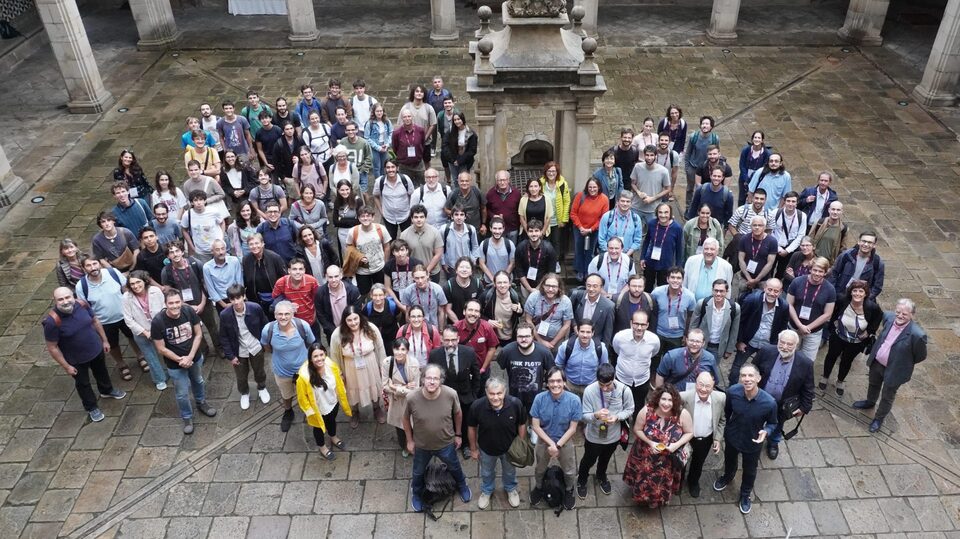
One conference picture of Adnan Mahmud at CRM Sept 2024 (wearing rucksack, 3rd in left from the left- and fore- pillar in the centre).
 M A A
M A A 