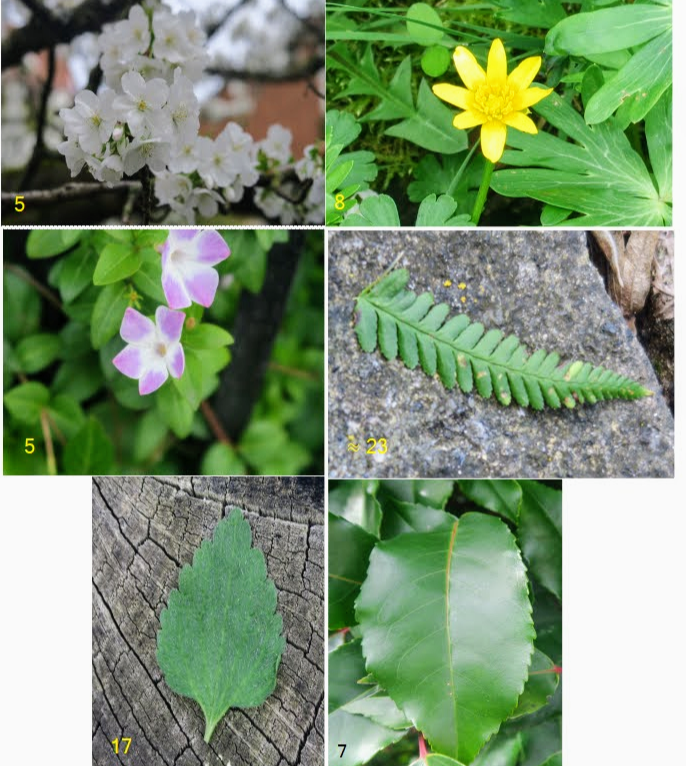
The spring of 2024 started with a new habit, that turned into a hobby, and eventually, a fascinating observation. Counting the number of veins in either half of the leaf, I found a repeated pattern that the number is more likely to be an odd or prime number than even number (there were significantly minor anomalies of the order one in ten). The leaves ranged from different sizes, shapes, to species. Interested readers are welcome to carry out a further more rigorous exercise of collecting such leaf samples within different categories (of species, subspecies, source of collection etc.) to find out an accurate distribution of even, odd, and prime numbers. Below you can find a collage showing numbers at the bottom-left of each picture, and the number is not restricted to number of veins in one half of the leaf, but also includes, numbers of indents in one half, number of leaflets. The veins act as channel to transfer the nutrients from the source (soil, environment, sunlight) to the body of the plant. The striking question is: what good do these odd/prime numbers of veins do to the leaf (if at all!)? This observation could motivate part II-B students to carry out an expeditory project involving collecting leaves from different parts of a plant (say, 1 metre tall) and finding out percentage of leaves with odd/even/prime number of stalks in their either half (including the leaves whose stalks were not easily uncountable).
The period while I was collecting these leaves coincided with a recent celebration of Timothy Gowers’ 60th birthday. The highlights of the 4-day event were: release of a new website (erdosproblems.com) by Thomas Bloom, celebration of Avi Wigderson’s Turing award accompanied by his talk (he also give another talk in CACW24 on the MIP*=RE), Terry’s talk on the proof and formalisation of the PFR conjecture, and much more. Summary of the event by Gil Kalai is here. One major development after this event is a flurry of Erdös open problems being solved and updated on the “hall of fame” of the website. A few set of problems related to transcendentality of limits of certain additive series (more on this, later) attracted me. Independent of this event, after 7 weeks, Guth and Maynard released an improved bound on the zero-density estimates for Dirichlet polynomials (talks here and here). More recently, an expository article by Terry on using graphs to collate improved bounds across the literature, by taking a specific example of list of zero-density theorems since 1905, offered a holistic lens to the Guth-Maynard 2024 result. (Update 19 Dec ’24: In fact, owing to ongoing discussion related to building infrastructure for mathematics, in the form of a centralised computing resource, that can inspire professional and amateur mathematicians to run their local maths models, one potential II-B project, that would be of software development nature is as follows. The .pdf files of a batch of maths research papers could be converted to a LaTeX version using Mathpix (it works with nearly 100% accuracy) and then parsed using an LLM model to identify the key innovations (inequalities, laws, principles etc.) used in the paper to arrive at the main theorems. A software package that can create such an inequality-chasing framework, as suggested by Terry, would create a modular version of the research articles available on the web, focusing on the key results and steps in the article. A large-scale implementation of this, perhaps in a GUI setting similar to aXi, would allow researchers to easily convert any maths paper on arXiv or in a .pdf format to a modular, easily-readable version).
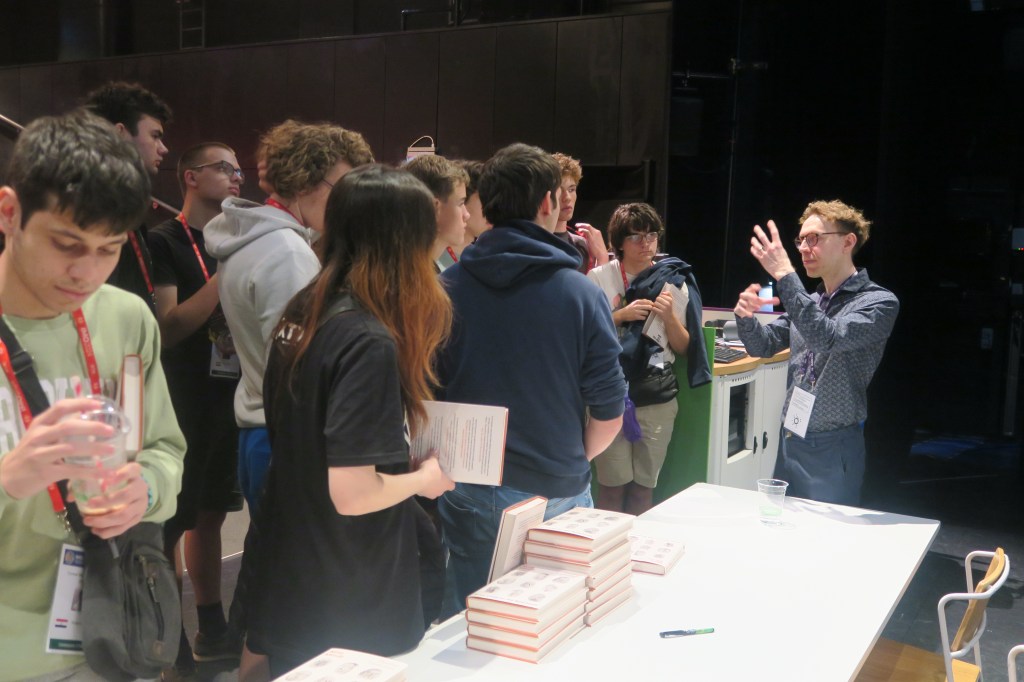
Post-spring, the start of the summer added one more layer to the thoughts above. Daniel Tammet, the famed writer and savant, was recently on a book launch tour of his recent release (Nine Minds: Inner Lives on the Spectrum). While retelling his story of memorising 22,514 digits of pi, he recounted how the process of memorising those numbers was for him. It was a process of finding his “home”, where he felt belonged. Memorising an astronomical amount of these integers was like sculpting pi’s narrative for him (largely stimulated by: his school lessons where only few decimal places for pi were taught, buying his first computer motivated him to print out so many numbers of digits, and synaesthesia in his mind where colours and numbers are conflated). In fact, we met again in July 2024, during the International Mathematics Olympiad held at the University of Bath (picture attached).
The anthological collection of the thoughts above, whilst appearing disjoint and disconnected, are largely connected for me – watch this space for further developments in each front.
I conclude by dedicating this post to the twin savants, interviewed by Oliver Sacks, who had amazing abilities to utter up to 20 digit prime numbers, in a joyful, playful, spirited, and casual homely conversational setting. The story of how they were withdrawn apart, so that they can live “normally”, which lead to them losing their abilities is a story replete with emotions of brotherly love, playing fun games, and an unfortunate separation.
P.S.: A painting gifted by a friend to earmark the aforementioned observation on leaves is shown below. It is a vintage lithograph impression of antique botanical engraving by a 17th century Dutch botanist and botanical artist Abraham Munting.

 M A A
M A A 