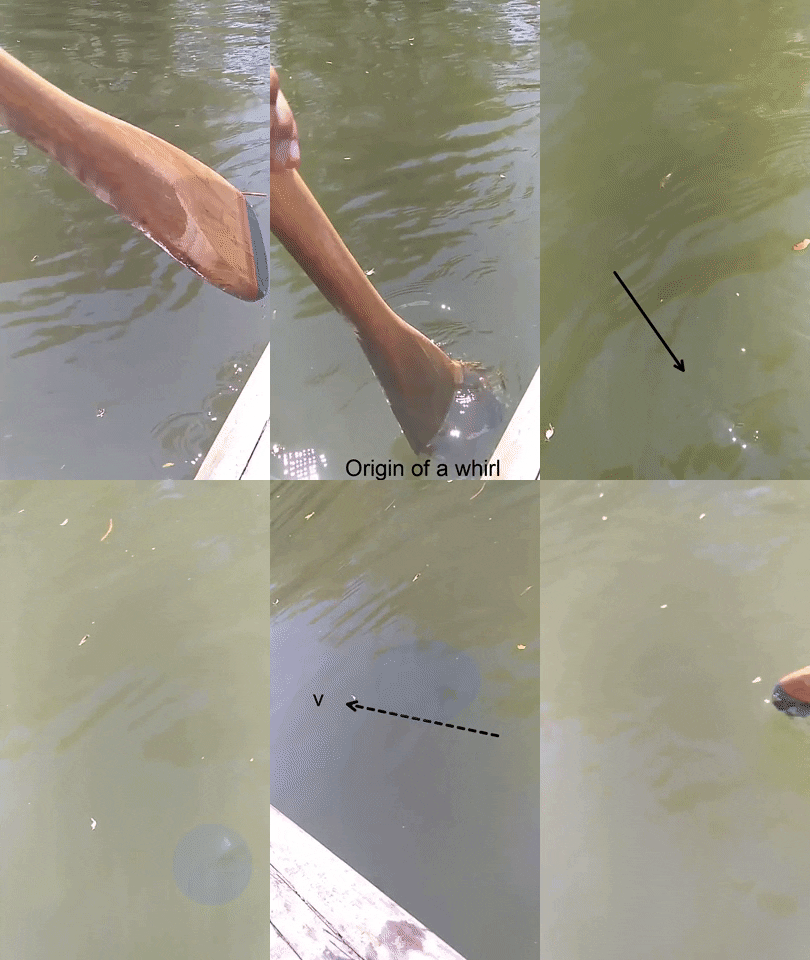
As I punt down the Cam river, I see my friend paddling leisurely. Much of this action can be deemed trivial and of not-so-importance use, until: you zoom at the moment, when the paddle touched the surface of water; let this moment play for a while, you see two small whirlpools (and bubbles underneath) originating from two ends of paddle; see them grow in action, they move with the speed of water-gravity waves and spready away to vanish after some time. If you play this moment again and again, what becomes more profound as an observation is the origin of whirpools and bubbles underneath once the water-interface is broken by an enormous force applied by my friend. The first point of contact of paddle with water-interface, I guess (from studying literature), creates a cusp-shaped dump in the interface where the Reynolds number is too high. Vortices are formed, as a result, to enable and sustain such high velocity fields. However, it’s not the velocity, but vorticity and its conservation that enables us to grasp the complexity of this observation. Much at the very beginning, when water-interface is just broken-off, it is the solution of Navier-Stokes equations that is changed from completely deterministic to a non-deterministic (at the point of contact of paddle) case. Non-deterministic means that, at and around the point of contact, the Re number is so high that continuum hypothesis doesn’t hold correct. Hence, it means that equations can’t yield any solution. A few questions arise here now:
- Is this singularity physical or mathematical in nature?
- Can the finite-time singularity be looked in reverse-time fashion: starting from when it’s originated?
- Can this singularity be zipped-up with a mathematical (if it’s mathematical) or physical (if it’s physical) argument?
Recent work by Moffatt (2020) [1] explained a situation of two counter-rotating vortices which approach each other, collide and cause vortex reconnection. In this work, the equations belong to the class of dynamical system in nature – without any stable point. Unavailability of such a point means that the solutions will evolve with time to reach large numbers because of the absence of any attractor, or even bifurcation. Ultimately, the result is such that for Re~2750, the continuum hypothesis breaks because certain length scales below atomic scale are reached. It means that the solutions do reach singularity but it’s entirely physically created. The question of whether the equation reach singularity in finite-time is still mathematical in nature; on the belief that it, indeed, is the case that it is mathematical- and, how to prove it? – an approach from a physical perspective will not be enough.
[1] Moffatt, H. K., & Kimura, Y. (2020). Towards a finite-time singularity of the Navier–Stokes equations. Part 2. Vortex reconnection and singularity evasion–CORRIGENDUM. Journal of Fluid Mechanics, 887.
 M A A
M A A 